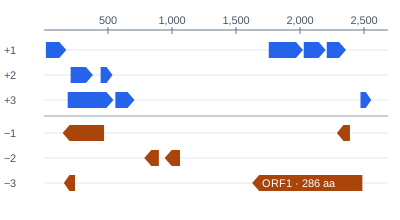
pUC19 cloning vector
Find candidate ORFs in a common cloning vector.
Paste DNA or FASTA to list every open reading frame, read its protein and draw an ORF map.
Calculating…
Enter a valid sequence to see its ORFs.
Calculating…
Explore plasmids, genomes and transcripts with different search settings.
Find candidate ORFs in a common cloning vector.
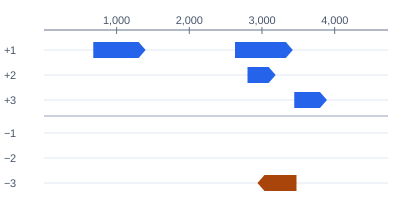
Locate the reporter and resistance ORFs.
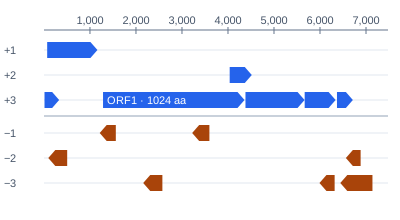
Explore alternative starts using bacterial code 11.
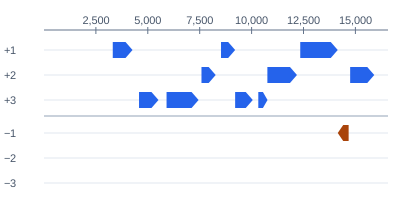
Compare mitochondrial coding with the standard code.
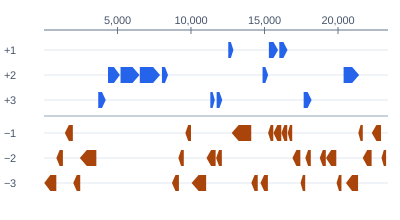
Find ORFs in a 23.4 kb bacterial operon region.
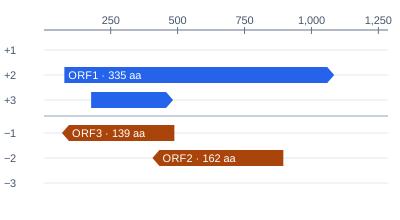
Find coding sequences in three transcripts at once.
Find, inspect and export open reading frames in four steps.
Paste DNA or FASTA, or open a sequence file.
Set the minimum length, start codons and genetic code.
Select an ORF in the map or table and copy its protein.
Download the map or export your sequences and table.
The six lanes show candidate ORFs on both strands.
An open reading frame runs from a start codon to an in-frame stop codon. The reading frame determines how bases are grouped into codons. Nested ORFs share a stop codon with an earlier start in the same frame.
+ frame = ((start − 1) mod 3) + 1
− frame = ((L − end) mod 3) + 1
aa = nt / 3 − 1
References: NCBI ORFfinder
Alternative starts depend on the genetic code. The bacterial code, for example, permits GTG and CTG as initiators.
| Gene | ATG only | ATG + alternative | Any sense codon |
|---|---|---|---|
| lacI | 202 ATG | 70 GTG | 46 CGC |
| lacY | 4410 ATG | 4380 CTG | 4365 CCG |
| lacA | 5733 ATG | 5667 ATC | 5664 GCA |
| Genetic code | Start codon | Protein |
|---|---|---|
| 1. Standard | TTG, CTG, ATG | — |
| 2. Vertebrate Mitochondrial | ATT, ATC, ATA, ATG, GTG | TGA: * → W, ATA: I → M, AGA: R → *, AGG: R → * |
| 4. Mold Mitochondrial; Protozoan Mitochondrial; Coelenterate Mitochondrial; Mycoplasma; Spiroplasma | TTA, TTG, CTG, ATT, ATC, ATA, ATG, GTG | TGA: * → W |
| 5. Invertebrate Mitochondrial | TTG, ATT, ATC, ATA, ATG, GTG | TGA: * → W, ATA: I → M, AGA: R → S, AGG: R → S |
| 11. Bacterial, Archaeal and Plant Plastid | TTG, CTG, ATT, ATC, ATA, ATG, GTG | — |
| 12. Alternative Yeast Nuclear | CTG, ATG | CTG: L → S |
References: NCBI The Genetic Codes
Paste or open a sequence, then set the minimum length, start codons and genetic code. The tool searches six reading frames in your browser and lists positions, lengths and proteins.
An earlier in-frame start can make an ORF longer than the annotated gene. For example, allowing alternative starts finds lacY from CTG at position 4,380. The actual start depends on biological and experimental evidence.
Frameshifts, introns, incomplete stop codons or a different genetic code can split or hide an ORF. E. coli prfB uses a programmed +1 frameshift, and some human mitochondrial stop codons are completed by polyadenylation. Use mRNA or cDNA for spliced genes.
Choose a threshold for your question: 75 nt is a common starting point, while 300 nt focuses on longer candidates. Short ORFs need independent evidence.
Choose the code appropriate to the organism and compartment: standard code 1 for most nuclear genes, 2 for vertebrate mitochondria, and 11 for bacteria, archaea and plastids.
Positions use ascending coordinates on the original sequence and a separate strand column. For an ORF crossing the origin, the Location field lists both segments; Start and End are its ordered endpoints. NCBI ORFfinder writes reverse-strand positions in the opposite order.
With matching settings, the same start-to-stop ORFs are found. NCBI also offers SmartBLAST; this tool supports multiple sequences and map export in the browser.
Yes. Export GenBank with ORF features and open it in the Plasmid Map Maker.
Yes. Use the Reverse Complement Calculator to translate DNA to protein across all six frames.